
TENSION SPRING
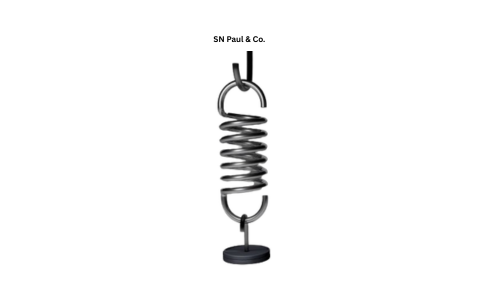
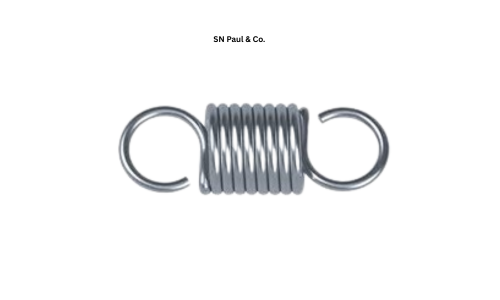
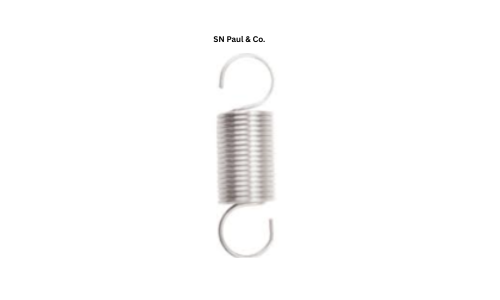
Our high-performance Tension Springs are designed to absorb and store energy by creating an industrial resist ance to a pulling force. Wound with an intentional initial tension that holds the coils tightly closed, these units are equipped with premium-grade terminal ends to guarantee strong attachment stability under continuous cyclic workloads.
S.N. Paul & Co. is a premier industrial manufacturing firm specializing in engineering high-resilience components for heavy machinery and infrastructure. With decades of industrial manufacturing expertise, we deliver precision-crafted mechanical solutions that meet international standards for durability and performance.
Tension Spring Manufacturer
Tension springs operate with tight structural coils and require highly customized end loop configurations to securely interface with mechanical assemblies. Our CNC coiling stations ensure uniform initial tension and high dimensional accuracy for heavy-duty industrial applications.
Specs Of Manufacturing
- Wire Diameter Range: Coiled from high-tensile wire profiles spanning 0.4 mm up to 40 mm.
- Outer Diameter Bounds: External housing tolerances scaled up to 350 mm.
- Free Length Capacity: Extended coil bodies engineered up to 1500 mm.
- Initial Tension Calibration: Statically balanced to match user-specified breaking loads and elongation constraints.
- Terminal End Formats: Machine hooks, full loops, crossover loops, extended side hooks, and custom threaded inserts.
- Raw Material Options: High-carbon steel wire, oil-tempered alloy wire, Chrome-Silicon (CrSi), and premium Stainless Steel (Grade 302, 316).
Understanding Tension Spring Mechanics We Supply
A Tension Spring (also known as an extension spring) operates on the exact opposite mechanical principle of a standard compression spring. While compression springs resist being squeezed, a tension spring is tightly pre-stressed during the coiling phase to resist being pulled apart. When an external tensile force stretches the spring body, the individual wire sections undergo torsional deflection, collecting mechanical energy that pulls the mechanisms back to their starting coordinates.
The defining parameter inside a tension spring is its **Initial Tension**. This is the internal force that tightly binds adjacent coils against each other without an external load. Before the spring body begins to stretch or separate even a fraction of a millimeter, the applied pulling force must completely overcome this built-in initial tension barrier. This unique physical trait allows engineers to hold components tightly together under precise preload constraints.
Critical End-Loop Classifications
The integrity of a tension spring depends heavily on the geometry of its attachment loops. Because the highest concentration of mechanical stress occurs at the transition bend between the spring body and the loop, we manufacture specialized end styles tailored to different stress limits:
1. Machine Hooks & Full Loops Supplier
These standard configurations are formed by raising the final active coils of the spring body to stand perpendicular to the outer circumference. Machine loops offer low production costs and excellent versatility for standard machine linkages and industrial counter-balances.
2. Crossover Center Loops Supplier
To reduce lateral twisting forces, the wire is bent sharply across the exact centerline axis of the spring before forming the final attachment circle. This ensures that the external load pulls symmetrically along the dead-center line of the spring, minimizing stress concentration points and extending service life.
3. Threaded Inserts & Swivel Hooks Supplier
For high-tonnage industrial systems where standard wire hooks might bend or snap, we fit separate threaded steel plugs directly into the open ends of the coils. A heavy-duty independent bolt or swivel eyelet can then be attached, allowing the assembly to handle massive pulling forces safely.
Operational Applications and Quality Measures We Ensure While Supplying
Our tension components are heavily utilized in heavy-duty agricultural mechanisms, automotive trunk linkages, overhead garage door counter-balances, and large-scale manufacturing conveyor mechanisms. To prevent sudden failures at the hook transitions, all loops are monitored using digital laser measuring systems during the forming phase. Components undergo precision low-temperature baking cycles to relieve inner stresses, ensuring the initial tension remains constant over millions of pulling cycles.
Tension Spring Price Structure
Pricing matrices are calculated per production batch based on wire grade mass, loop forming complexity, and force testing requirements, typically falling into the following structural price bands:
- Standard Mechanical Linkage Springs: Fabricated from durable carbon steel or stainless steel wires with machine hooks for general sub-assemblies. Estimated range from ₹ 250 to ₹ 1,500 per piece.
- Heavy Industrial Pull-Back Units: Engineered from heavy-gauge alloy bars with custom crossover loops or threaded plug ends for industrial cranes and mining systems. Price ranges from ₹ 3,500 to ₹ 22,000+ per piece.